
Most short-term rental operators don't have a software problem. They have an execution problem. A Property Management System (PMS), pricing tool, smart locks, digital guidebooks, and a shared inbox often feels like a complete stack. But as a portfolio grows, these platforms depend on your staff to manually connect everything behind the scenes.
Guest questions come in through one channel, tasks get handled in another, and property information lives somewhere else entirely. Teams end up wasting valuable time searching for context instead of solving the problem in front of them.
Whether you manage 50 units or 1,000+, this eventually shows up in the metrics that matter: slower response times, missed upsell opportunities, lower review scores, and, ultimately, pressure on occupancy, ADR, and RevPAR.
The challenge is no longer finding software. It's making it work together.
Why Building an STR Tech Stack Has Become So Difficult
In today's highly-saturated market, operators feel overwhelmed by choice. Plus, they all promise they'll save you time, automate operations, improve the guest experience, and increase revenue. Yet more often than not, hosts end up managing these systems instead of benefitting from them.
At the end of the day, you need tools that work together to support growth without requiring additional headcount or sacrificing quality.
Why STR Tech Stacks Break at Scale
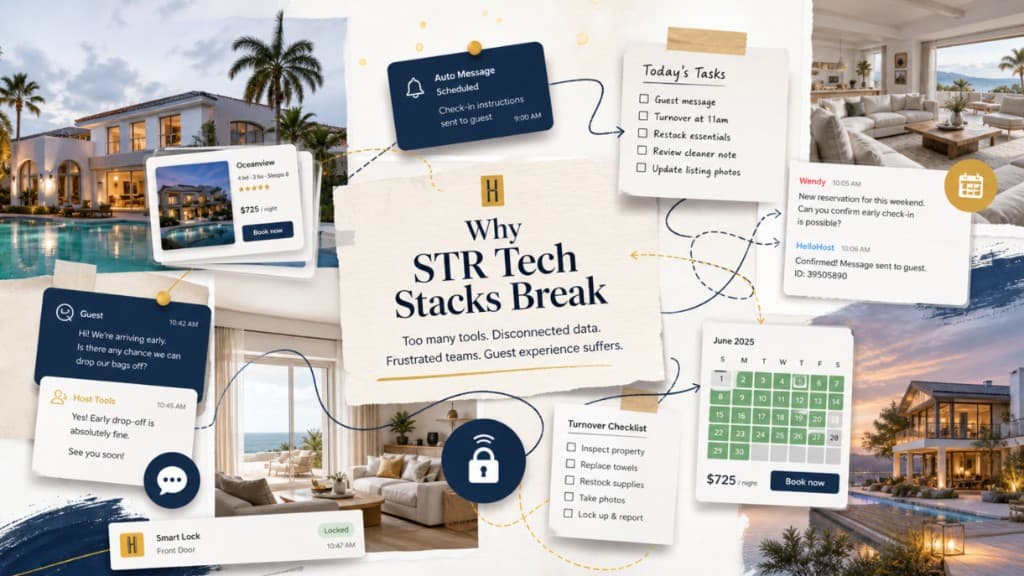
Most STR tech stacks don't fail because they're missing tools. They fail because the tools available to them are a collection of point solutions, not operating systems. Nothing is coordinating the work across those systems.
A single guest request can trigger multiple follow-up actions: verify whether early check-in is possible, confirm housekeeping status, review same-day turnovers, message the guest, and update the team. Each step depends on someone reading the message, deciding what needs to happen, and coordinating the work manually.
At 20 units it's manageable. At 200 it breaks. At 500 it becomes chaos.
The result isn't just slower operations. Every manual handoff introduces opportunities for missed messages, delayed cleanings, inconsistent service, and unnecessary labor costs. As portfolios grow, those small inefficiencies compound into real operational expenses.
HelloHost: AI Agents for STR Operators
This is the problem HelloHost was built to solve. While most AI platforms focus on answering guest messages, HelloHost was designed to coordinate the operational work those conversations create. Built from our CEO's firsthand experience managing short-term rentals, the platform extends beyond guest communication into day-to-day operations.
HelloHost is a multi-agent AI platform that integrates with your PMS to turn data into action. Using multiple sources for context, it automates guest communication, triggers task workflows, and helps teams operate consistently across an expanding property portfolio.
With two purpose-built AI agents dedicated to guest communication and operations, we can handle up to 80–90% of routine guest messages, only involving you when absolutely necessary.
The Guest Communication Agent manages the conversation. The Operations Agent coordinates everything that happens next.
The Five Must-Haves in your Tech Stack
1. PMS: The Foundation
To start, every serious operator needs a PMS. Whether that's Guesty, Hostaway, OwnerRez, Hospitable, Streamline, or another platform, the PMS serves as the system of record for reservations, calendars, rates, guest information, and listing data.
There's no universally "best" PMS. The right choice depends on your portfolio size, operational complexity, and the workflows your team needs to support. The goal isn't to find the platform with the longest feature list. It's to choose one that fits the way your business actually operates.
Without a PMS, calendars are not synced properly, you risk double bookings, blocked dates, and lost occupancy. With your listing and reservation data fragmented, your team can't trust the reservation data, so they spend more time juggling data than improving guest experience.
A well-configured PMS helps operators:
- Keep calendars and booking channels in sync
- Maintain accurate reservation data
- Reduce manual errors
But a PMS is designed to manage reservations, not execute the operational work that surrounds them.
That's where many tech stacks begin to break down.
2. Revenue Layer
Every serious STR operator tracks occupancy rate, ADR, and RevPAR. Tools like PriceLabs, Beyond Pricing, and Wheelhouse optimize your rate strategy, but operations protect it.
Every operational failure eventually has a financial consequence:
- ADR becomes harder to sustain when service quality declines.
- Occupancy decreases with poor reviews from inconsistent check-ins or delayed communication.
- RevPAR suffers when revenue gains are offset by hiring more staff to run operations.
It isn't just about charging the right price. It's about operating well enough to justify it.
3. Risk Layer
Guest verification platforms such as Superhog and Truvi help reduce fraud, party risk, and potential damage before arrival. However, those safeguards only work if guests actually complete the required verification. In reality, many guests skip or overlook pre-arrival instructions, creating additional follow-up work for your team.
HelloHost integrates with these platforms to proactively guide guests through the process, answer common questions, and send reminders when action is still needed. The result is a smoother guest experience and fewer manual follow-ups for your team.
4. Guest Communication Layer
Guest communication is one of the few parts of your operation that every guest experiences firsthand. Fast, accurate, and personalized responses don't just improve satisfaction. They influence review scores, encourage repeat bookings, reduce support volume, and create opportunities for additional revenue through upsells.
While smart locks, digital guidebooks, and guest-facing technology contribute to the overall stay, communication is what connects those tools into a seamless guest experience. Guests shouldn't have to search for information or wait hours for an answer to a simple question.
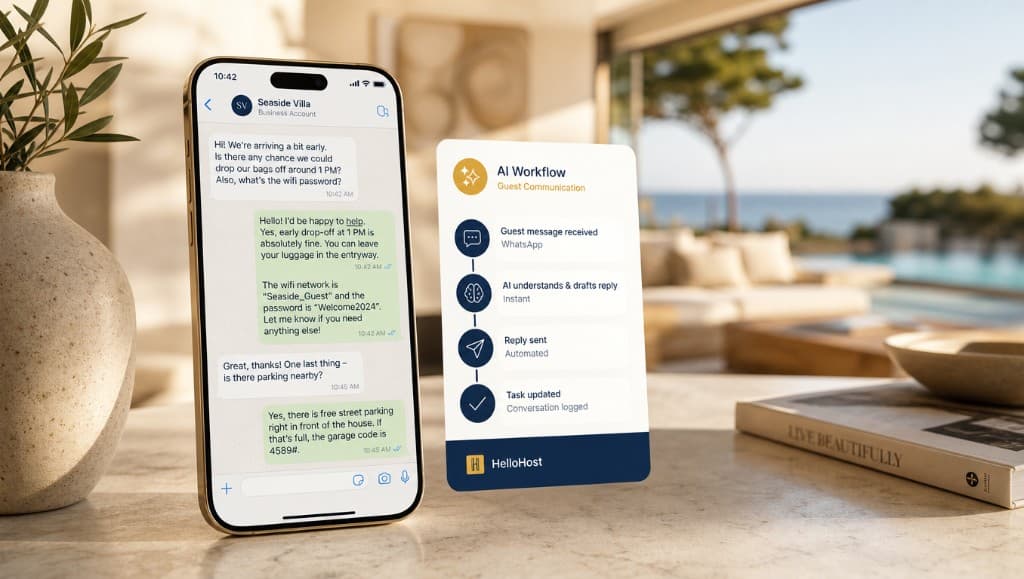
HelloHost's Guest Communication Agent learns your policies, SOPs, FAQs, and brand voice to deliver consistent, personalized responses around the clock. It can proactively anticipate guest needs by suggesting approved options, such as early check-in or late checkout, while following the operating rules you've established. It can also surface relevant upsell opportunities at the right point in the guest journey, helping increase revenue without creating additional work for your team.
The result is faster response times, more consistent guest experiences, and a communication process that scales alongside your portfolio instead of relying on additional staff.
5. Operations Layer
This is the layer most people underestimate.
As you know, a guest message is rarely just a message. It's a task in disguise.
A complaint about the AC requires notifying your maintenance team. An early check-in request requires coordination with cleaners.
If messages are answered but nothing else happens automatically, the team is still doing the heavy lifting manually.
HelloHost's Operations Agent bridges that gap by automatically identifying action items from conversations, creating tasks, and routing work to the right staff.
As portfolios grow, communication becomes harder to track across PMS notes, inboxes, SOPs, and task tools. Without an operations layer, teams spend more time coordinating work than doing it.
This is why purpose-built AI agents are rapidly becoming an essential part of modern STR tech stacks. The goal isn't simply to automate messages. It's to reduce repetitive work, standardize operations, and help the business grow without increasing headcount at the same pace.
Many operators invest heavily in the first four layers while leaving operations dependent on manual effort. But as the business expands, that method quickly leads to operational chaos.
HelloHost's Operations Agent, Built Directly into WhatsApp
Every minute spent searching for information is a minute not spent solving guest or operational issues. Communication no longer happens exclusively through PMS or OTA inboxes and email. For many operators, especially those managing international travelers and remote teams, WhatsApp has become a frontline operational tool. But when WhatsApp isn't connected to the rest of the tech stack, valuable context gets lost.
To solve this, we built the HelloHost operations AI agent directly into WhatsApp. It goes beyond simple auto-responses, acting as a true member of your team, capable of handling complex operational tasks and learning from your feedback to improve over time.
Rather than requiring your team to constantly monitor conversations, the AI only escalates situations that require human judgment or policy exceptions. Then, without leaving WhatsApp, you can tell the AI how to resolve the situation, draft, and send the approved response to the guest.
When a follow-up task is required, HelloHost automatically creates it, assigns it to the appropriate team member, and keeps the relevant conversation attached. Staff can update task status, add notes or photos, and complete the work without jumping between multiple systems.
The result is more time for your team to focus on hospitality, guest relationships, and revenue-generating activities like upsells.
What a Scalable STR Stack Actually Looks Like
Each part of your tech stack plays an important role, but their greatest value comes when they're connected through a cohesive operational workflow.
The PMS remains the foundation. Point solutions solve targeted problems. HelloHost's AI agents connect those systems together, helping the entire stack operate as one coordinated platform rather than a collection of disconnected tools.
Without HelloHost, growth creates complexity. Teams spend more time coordinating work, searching for information, and managing exceptions than creating exceptional guest experiences.
When you implement HelloHost, operations stop being something your team has to coordinate manually.
The most scalable tech stacks aren't the ones with the most software. They're the ones where every system works together.
If your team is still acting as the glue between disconnected tools, adding more tools won't solve the problem. You need a system that connects the work.
Book a demo to see how HelloHost helps growing operators automate guest communication, coordinate operations, and scale without adding headcount.